
Medical Literacy: Between Treatment Complications and the Responsibility of Doctors and Patients
In an age when social media has become crowded with medical content, what we truly need is genuine medical literacy—one that helps patients distinguish medical negligence from expected complications and recognizes the shared responsibility of doctors and patients.
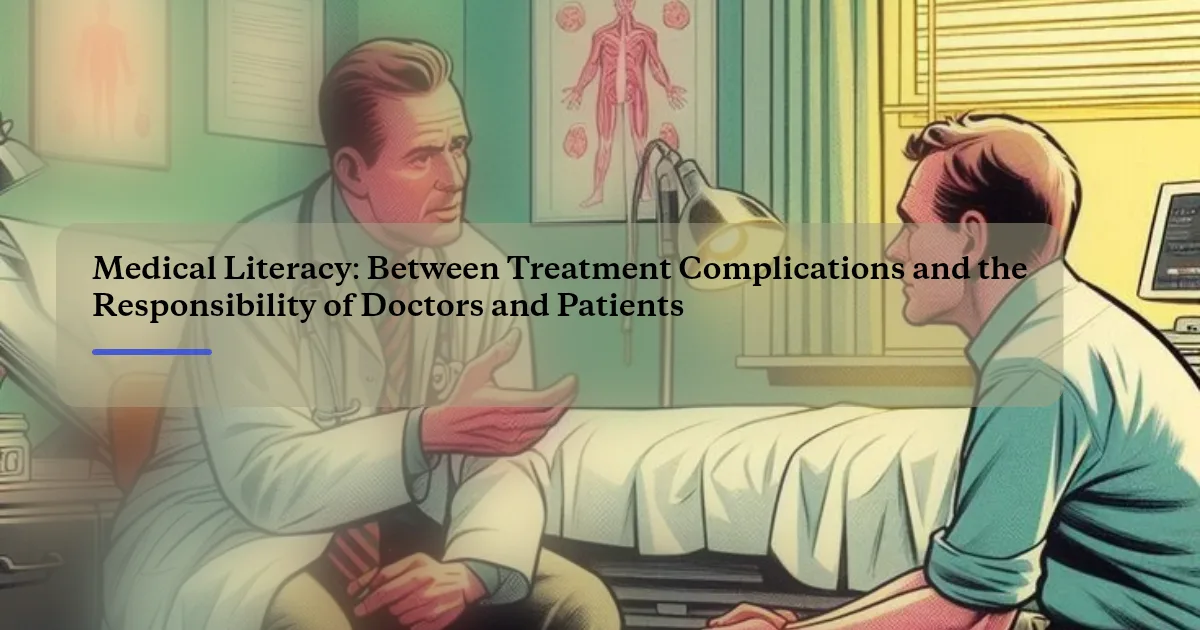
Medical Literacy
In recent years, social media has become crowded with medical content. Every few posts, we see a doctor talking about a particular disease, and every few videos, someone is explaining a surgical procedure or discussing a treatment.
But the more important question is not: How many doctors are talking about medicine online?
It is: How much of this content actually improves the public’s medical literacy?
A large amount of medical content on social media is ultimately a way for doctors to introduce themselves and promote their services. Sometimes it is presented through carefully arranged information and complicated medical terminology, which may lead viewers to believe that they are watching a doctor who can diagnose everything and solve every problem—the doctor who always "gets straight to the point," as people like to say.
Yet doctors can offer society something far more valuable than simply talking about diseases and operations.
They can teach people about the doctor-patient relationship, the limits of medicine, and the risks that naturally accompany medical treatment.
Patients need to understand the difference between gross negligence, genuine medical error, and complications that may occur despite appropriate medical care.
On social media, we often see patients sharing difficult experiences with doctors.
A patient undergoes surgery and later develops a wound infection.
Another undergoes an endoscopic procedure and suffers a complication.
Someone takes a medication and experiences a significant side effect.
Then the anger begins.
The patient condemns the doctor. People pray against him. Others accuse him of negligence, lack of conscience, or incompetence. Many join in, even though they have heard only one side of the story and may not know whether the complication was preventable, expected, rare, or completely unrelated to any medical error.
This is where doctors themselves have a responsibility.
As part of a proper professional relationship, physicians should explain, as appropriate, the expected benefits of a treatment or procedure, its possible risks, side effects, and complications.
But patients also have a responsibility.
We need to admit that many of our expectations about medicine are unrealistic.
We want a miraculous treatment with no complications.
We want medications without side effects.
We want a test that gives a definitive answer every time.
And we want a doctor who can always give us a certain answer that completely reassures us.
But medicine does not work that way.
There is no magical treatment without risks. No medical test can detect everything in every patient. And no surgical procedure can guarantee a perfect outcome for everyone.
The occurrence of a complication does not automatically mean that the doctor made a mistake.
Likewise, a treatment that fails does not necessarily mean that the doctor was negligent.
Medications have potential adverse effects. Surgical procedures have known complications. Diagnostic tests have limitations. And even the best physicians cannot control everything that happens inside the human body.
This does not mean that doctors are above accountability.
When there is genuine negligence, inadequate care, or a departure from accepted medical standards, patients have every right to ask questions, seek clarification, and pursue the appropriate professional or legal channels.
The problem begins when every bad outcome is immediately turned into a judgment against the doctor, simply because the result was not what the patient expected.
Patients need to learn, and doctors need to explain.
We need to move from the question:
"Who is to blame?"
to a more important set of questions:
"What actually happened? Was it a known complication? Was it preventable? And was appropriate medical care provided?"
These questions are fairer, more scientific, and less harmful.
Moving from ignorance to knowledge is not easy.
It requires years of learning, humility, and the willingness to admit that some medical decisions involve uncertainty. The best medical decision is not always the one that guarantees the outcome we hope for.
The responsibility does not belong entirely to doctors, nor entirely to patients.
Doctors are responsible for explaining honestly and clearly. Patients are responsible for learning and understanding, rather than building their judgments on incomplete stories or short social-media videos.
As medical literacy improves, rumors and unjust accusations have less room to spread. Conversations between doctors and patients become more mature, and society becomes better able to distinguish between a genuine medical error and a known complication that may occur despite appropriate care.
Perhaps what we need today is not simply more doctors talking about medicine, but more doctors teaching people how to understand medicine.
Source of the original text : Sabeel Al-Atebaa (Doctors’ Path) Channel